
Case Study Industrial equipment
From a proven ignition device to series production
Higher loads, new market requirements and a tight schedule: working with the customer, P&R took a proven industrial device into series production within six months.
Explore the project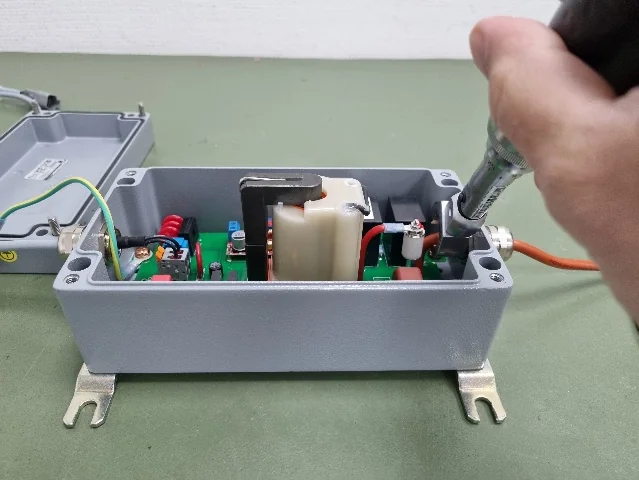
- From project start to series production
- 6months
- To develop and build the test system
- 3weeks
- Product and manufacturing developed together
- Seriesinstead of small batches
01 / THE CHALLENGE
A proven device faces new requirements
The ignition device had already been used successfully in industry for many years. For a new, safety-critical application, it needed to withstand more demanding environmental conditions. At the same time, its components, manufacturing processes and assembly operations had to be prepared for series production. Use in the American market was also planned.
The project plan allowed six months until the start of production. This period had to cover product certification by an external approval body, material procurement and the supply chain, an approved test facility, and approval of the production line.
02 / REQUIREMENTS
What the redesigned device needed to deliver
Thermal endurance
Withstand higher sustained thermal loads in the new application.
Mechanical robustness
Withstand highly dynamic vibration during transport and operation.
Longer service life
Redesign the existing device for an extended product lifetime.
Traceability
Maintain component traceability throughout procurement and manufacturing.
American market
Integrate the required approval into product and process development.
Cost-effective manufacturing
Reduce manufacturing costs and prepare for the transition to series production.
03 / IMPLEMENTATION
Product and production developed together
Design for Manufacturing
Develop the product and its assembly process together
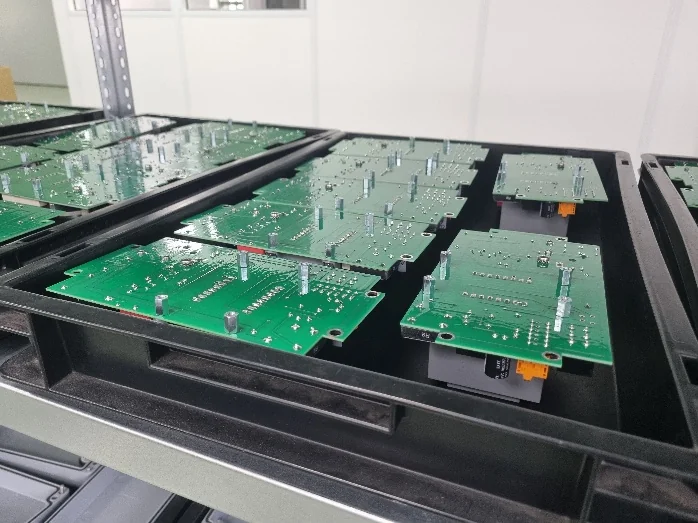
P&R applied Design for Manufacturing based on VDI 2221. After clarifying the requirements and conducting an in-depth analysis of the product and its production processes, the team adapted the PCB outline and enclosure for faster assembly.
Safety-critical components and those exposed to high loads were replaced with UL-certified products with higher performance ratings. Heavy components were additionally secured to the PCB. Components carrying high voltages were encapsulated using UL-approved materials.
Materials and supply chain
Identify cost drivers and align procurement
Recurring cost-structure and ABC analyses revealed opportunities for savings. Fewer than five components accounted for the majority of material costs. The procurement team regularly assessed these cost drivers against current prices and fed the results back to development and manufacturing.
An international supply chain reduced material costs. Supplier qualification strengthened procurement resilience.
PCB assembly and box build
Improve manufacturing processes for series production
Throughput times and ergonomics were optimised in THT assembly, wave soldering and manual THT soldering. P&R designed, built and tested dedicated holding and assembly fixtures. Electric and torque-controlled screwdrivers provided additional semi-automated production support.
A semi-automatic optical assembly and inspection system checks that all components are present and correctly positioned. This reduces the time required for manual optical inspection. The pre-tested and calibrated module is then installed in the metal enclosure.
Test system and quality assurance
Advance testing and certification in parallel
Certification by TÜV Süd ran alongside product development. The product design, bill of materials and scope of testing were defined during this process. Using this information, P&R and the customer developed and built a test system within three weeks, enabling safe, reproducible testing in accordance with occupational safety regulations.
During its final inspection of the manufacturing site, TÜV Süd reviewed the ISO 9001:2015 certificate, among other requirements. Manufacturing in accordance with IPC A-610 and IPC A-630, together with established processes for handling and tracing UL-certified components, supported this process.
Close collaboration with the customer
The customer, engineering team and procurement team worked closely together. This kept development iterations to a minimum and enabled the project to stay on schedule and within budget. The exchange of experience in box-build assembly is also expected to make future project start-ups easier.
04 / RESULTS
Series production within the planned timeframe
After six months, development was complete and the device had entered series production. Procurement, PCBA manufacturing, logistics, box-build assembly and quality monitoring were developed together to support this transition.
Series production established
The device is manufactured in series, with the agreed schedule and budget met.
Material costs reduced
An international supply chain and qualified suppliers combine cost savings with resilient procurement.
Quality monitored on an ongoing basis
Recurring factory inspections monitor compliance with the required IEC, DIN EN and UL standards.